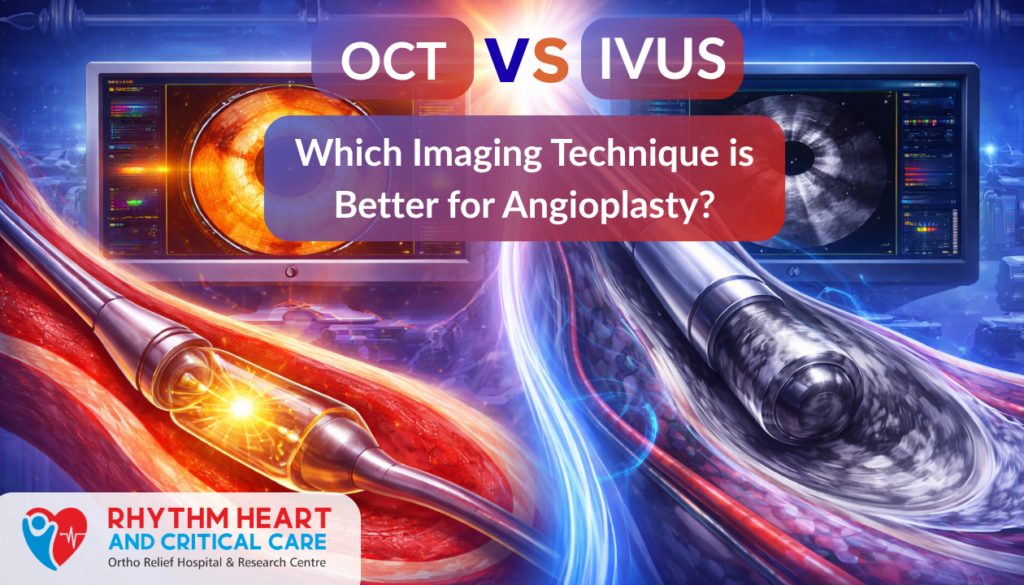
Selecting the appropriate imaging technique is essential for the success of angioplasty procedures. Which imaging technique is better for angioplasty, OCT versus IVUS, is a common question among patients and even healthcare professionals.
Both Optical Coherence Tomography (OCT) and Intravascular Ultrasound (IVUS) are high-tech tools used to look inside the coronary arteries.
At Rhythm Heart & Critical Care Hospital, a leading heart hospital in Nagpur, we use these cutting edge imaging tools to ensure accurate diagnosis and better treatment outcomes for patients undergoing coronary angioplasty and other cardiac procedures.
OCT vs IVUS: Which Imaging Technique is Better for Angioplasty? Detailed Overview
When considering OCT in comparison to IVUS: Which Imaging Method is Superior for Angioplasty?, it is crucial to examine how both techniques aid in precise diagnosis and treatment preparation. OCT provides exceptionally clear, detailed visuals of the inner surface of arteries, assisting physicians in recognizing tiny plaque characteristics and stent positioning problems.
In contrast, IVUS provides a wider and deeper visualization of the vessel, allowing better assessment of overall artery structure and blockages. Both technologies play a vital role in enhancing the precision and safety of modern angioplasty procedures.
OCT vs IVUS: Which Imaging Technique is Better for Angioplasty? – Key Differences
| Factor | OCT (Optical Coherence Tomography) | IVUS (Intravascular Ultrasound) |
|---|---|---|
| Technology Used | Uses near-infrared light waves | Uses ultrasound (sound waves) |
| Image Resolution | Very high resolution (microscopic detail) | Moderate resolution |
| Depth of Penetration | Limited depth (surface-level imaging) | Deeper penetration into vessel walls |
| Plaque Visualization | Excellent for detailed plaque analysis | Good for overall plaque burden |
| Stent Placement Accuracy | Highly precise due to clear imaging | Helps in sizing and expansion of stents |
| Need for Contrast Dye | Requires contrast dye | No additional contrast needed |
| Suitability | Best for detailed artery surface analysis | Best for larger vessels and deeper study |
| Procedure Time | Slightly longer due to imaging steps | Relatively quicker |
| Safety | Safe but limited in kidney patients (due to dye) | Safer for kidney patients |
| Cost | Slightly higher due to advanced technology | More cost-effective |
| Usage in Angioplasty | Ideal for complex and detailed cases | Widely used for routine assessment |
| Availability | Limited to advanced cardiac centers | More widely available |
1. Imaging Technology Used
OCT utilizes near-infrared light to produce highly detailed images of the inner lining of blood vessels. It offers very clear details at a tiny level, which makes it great for identifying the features of plaque. IVUS uses sound waves to look deeper into the walls of arteries.
Both technologies are widely used in advanced cardiac care in Nagpur, helping doctors decide the best treatment approach for each patient during angioplasty procedures.
2. Image Resolution
OCT offers extremely high-resolution images, making it easier to identify thin plaques, stent malposition, or minor blockages. IVUS provides lower resolution compared to OCT but gives a wider and deeper view of the artery.
At Rhythm Heart & Critical Care Hospital, both techniques are used based on patient needs to ensure accurate diagnosis and effective heart treatment in Nagpur.
3. Depth of Penetration
IVUS has a greater depth of penetration, allowing doctors to visualize the entire artery wall and surrounding structures.
OCT has limited penetration but provides highly detailed surface images. This difference makes IVUS suitable for larger vessels, while OCT is preferred for detailed plaque analysis during coronary angioplasty.
4. Clarity of Plaque Assessment
OCT is superior in identifying plaque composition, including calcium deposits and fibrous caps. It helps in detecting vulnerable plaques that may cause heart attacks.
IVUS provides a broader overview but may not capture such fine details. Accurate plaque assessment is essential for successful angioplasty in Nagpur.
5. Use of Contrast Dye
OCT needs a contrast dye to remove blood from the imaging zone, which might not be appropriate for those with kidney problems.
IVUS does not need any extra contrast, making it a safer option for these patients. At our cardiac care hospital in Nagpur, cardiologists thoughtfully select the method depending on the patient’s condition.
6. Procedure Guidance
Both OCT and IVUS assist in directing stent placement when performing angioplasty. OCT guarantees accurate stent location because of its excellent resolution, and IVUS verifies correct expansion and the size of the vessel.
Employing these technologies enhances results in coronary angioplasty treatments.
7. Safety and Effectiveness
Both OCT and IVUS are safe, reliable imaging techniques used in modern cardiology. OCT offers highly detailed visualization for precise stent placement, while IVUS provides a broader view of the artery.
Together, they improve accuracy, reduce complications, and enhance overall angioplasty outcomes for better long-term heart health.
8. Cost and Availability
OCT is generally more advanced and slightly costlier due to its high-resolution imaging capabilities, whereas IVUS is more widely available and commonly used.
However, the selection of either technique depends on patient condition and clinical needs, ensuring the most effective and appropriate treatment approach.
Which Imaging Technique Should You Choose?
The choice between OCT and IVUS depends on individual patient conditions, artery size, and the complexity of blockage. Both techniques have unique advantages and are often used together for better results.
At Rhythm Heart & Critical Care Hospital, our experienced cardiologists evaluate every case carefully and recommend the most suitable imaging method for safe and effective angioplasty in Nagpur. Early diagnosis and advanced imaging significantly improve treatment success and long term heart health.
Conclusion
If you or your loved ones are experiencing chest pain, breathlessness, or symptoms of heart disease, don’t delay treatment.
At Rhythm Heart & Critical Care Hospital, we provide advanced cardiac imaging, expert diagnosis, and world-class coronary angioplasty in Nagpur.
Contact us today or book your appointment for a complete heart check-up and ensure the best care for your heart.
FAQ’s
1. What is OCT in angioplasty?
OCT (Optical Coherence Tomography) is an advanced imaging technique that uses light waves to create highly detailed images of coronary arteries during angioplasty.
2. What is IVUS used for in heart procedures?
IVUS (Intravascular Ultrasound) uses sound waves to visualize the inside of blood vessels and helps doctors assess artery blockages and guide stent placement.
3. Which is better: OCT or IVUS?
Both OCT and IVUS have their advantages. OCT provides higher resolution images, while IVUS offers deeper penetration. The choice depends on the patient’s condition and clinical requirement.
4. Is OCT safe for all patients?
OCT is generally safe but requires contrast dye, which may not be suitable for patients with kidney issues or certain medical conditions.
5. Does IVUS require contrast dye?
No, IVUS does not require additional contrast dye, making it a safer option for patients with kidney-related concerns.
6. Why are OCT and IVUS important in angioplasty?
These imaging techniques improve accuracy in diagnosing artery blockages, ensure proper stent placement, and reduce the risk of complications during angioplasty.
7. Can OCT and IVUS be used together?
Yes, in some complex cases, doctors may use both OCT and IVUS together to get more detailed and comprehensive information about the artery.
8. Are these imaging techniques painful?
No, both OCT and IVUS are minimally invasive and performed during angioplasty, causing little to no additional discomfort to the patient.
9. How do doctors decide between OCT and IVUS?
The choice depends on factors like artery size, type of blockage, patient health, and the need for detailed imaging or deeper vessel analysis.
10. Where can I get advanced angioplasty with OCT and IVUS?
You can visit a specialized cardiac care center like Rhythm Heart & Critical Care Hospital for advanced imaging and expert angioplasty treatment.
Reference: