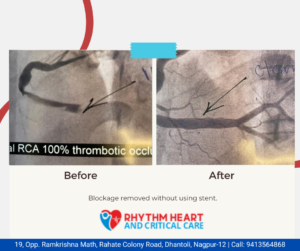
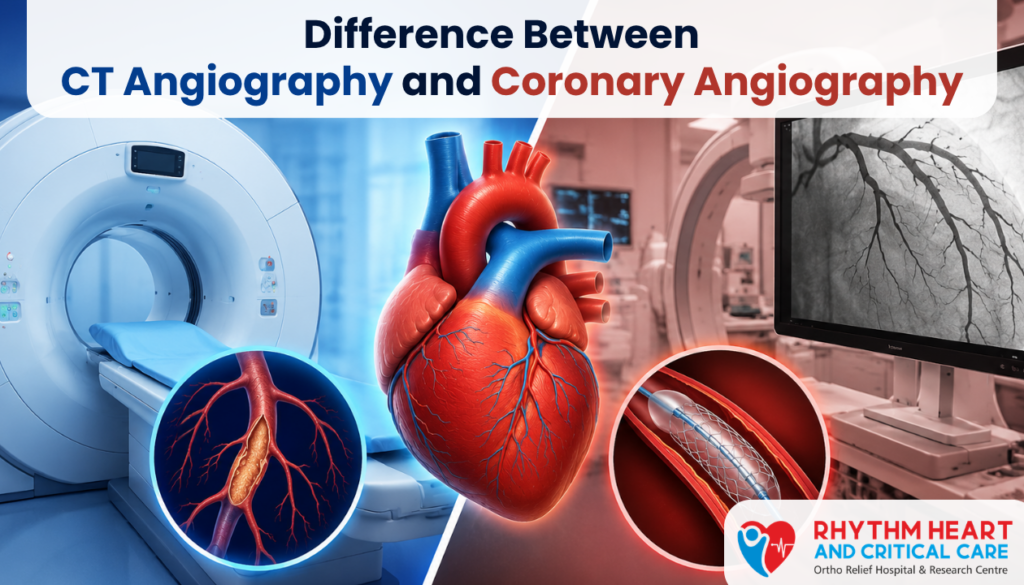
CT angiography is a non-invasive heart scan, while coronary angiography is an invasive procedure offering detailed artery imaging and treatment options.
Heart diseases are among the leading health concerns worldwide, making early diagnosis extremely important. Doctors often recommend imaging tests to evaluate blood flow and detect blockages in heart arteries.
Two commonly used diagnostic procedures are coronary angiography and CT angiography. Although both tests examine the blood vessels of the heart, they differ in technique, purpose, accuracy, and treatment approach.
Knowing the difference between CT angiography and coronary angiography can help patients make informed decisions regarding cardiac care. At Rhythm Hospitals, our advanced cardiac care and experienced cardiologists provide accurate diagnosis and heart treatment for better outcomes.
What Is CT Angiography?
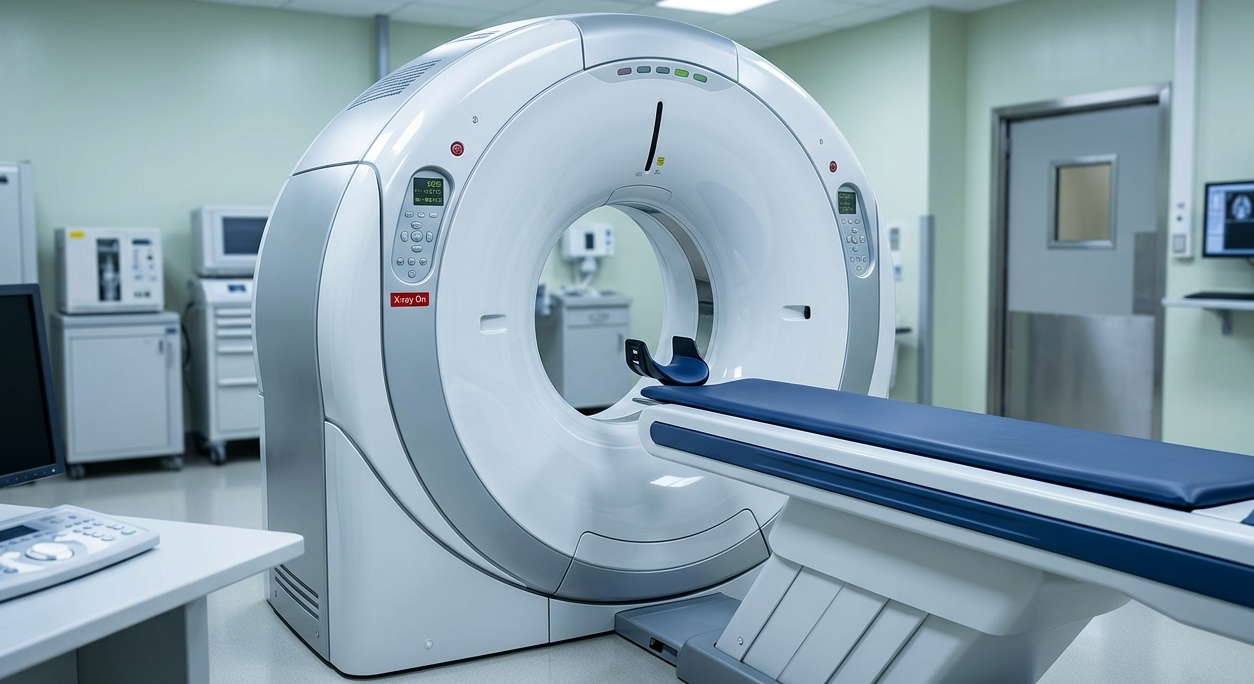
CT angiography, also known as CT coronary angiography, is a non-invasive imaging test that uses CT scan technology along with contrast dye to produce detailed images of blood vessels and coronary arteries.
This test helps doctors detect narrowing, plaque buildup, or blockages in the arteries that supply blood to the heart. ‘
CT angiography does not require a catheter and is preferred for patients with mild to moderate symptoms or when physicians need an initial assessment of coronary artery disease.
What Is Coronary Angiography?
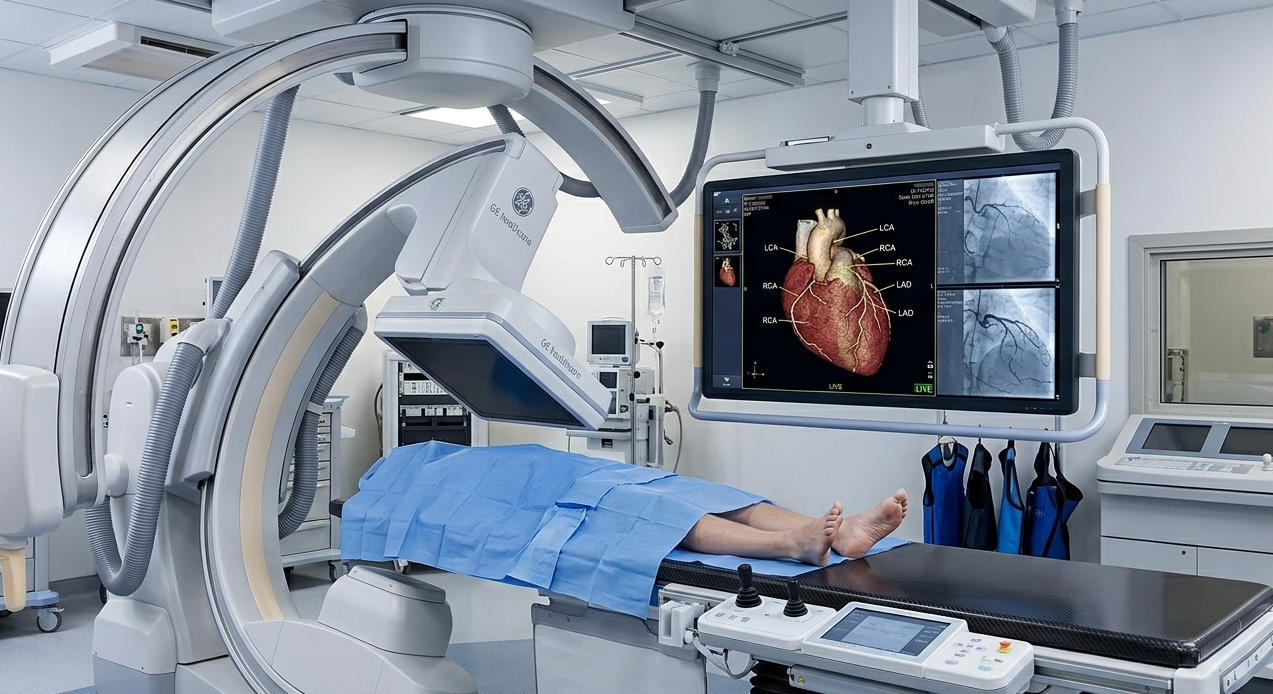
Coronary angiography is an invasive diagnostic procedure performed in a cath lab. During the procedure, a thin catheter is inserted through the wrist or groin and guided toward the coronary arteries.
A contrast dye is injected so that doctors can use X-ray images to see blood flow and identify blockages. Coronary angiography is very accurate and can be combined with angioplasty if a blockage is detected.
This procedure is widely used in modern cardiac therapy and emergency cardiac therapy.
Difference Between Coronary Angiography and CT Angiography
| Feature | CT Angiography | Coronary Angiography |
| Procedure Type | Non-invasive scan without catheter insertion | Invasive procedure involving catheter placement |
| Imaging Technique | Uses CT scan and contrast dye for high-resolution images | Uses real-time X-ray imaging and dye through catheter |
| Hospital Stay | Usually same-day discharge | May require monitoring or short hospital stay |
| Purpose of Test | Early diagnosis and detection of artery narrowing | Detailed diagnosis and treatment planning |
| Accuracy in Detecting Blockages | Highly effective but may be less definitive in some cases | Considered the gold standard for blockage detection |
| Risk and Complications | Lower risk due to non-invasive nature | Small risks like bleeding, infection, or artery injury |
| Treatment Possibilities | Diagnostic only, cannot treat blockages | Can be followed by angioplasty or stent placement |
| Time Required | Usually 15–30 minutes | May take longer due to preparation and monitoring |
| Recovery Period | Quick recovery with normal activities resumed soon | Short recovery period with temporary activity restriction |
| Suitable Patients | Low to moderate-risk patients with suspected heart disease | High-risk patients or those with severe symptoms |
1. Procedure Type
CT angiography is a non-invasive diagnostic scan that does not involve catheter insertion into the arteries.
In contrast, coronary angiography is an invasive procedure in which a thin catheter is inserted into the wrist or groin and guided into the arteries of the heart.
2. Imaging Technique
CT angiography uses advanced CT scan technology combined with contrast dye to produce detailed images of blood vessels and coronary arteries.
Coronary angiography uses real time X-ray imaging and contrast dye delivered through a catheter for direct artery visualization.
3. Hospital Stay
Patients undergoing CT angiography usually require minimal monitoring and can go home the same day.
Coronary angiography may require several hours of observation or a short hospital stay, depending on the patient’s condition and the outcome of the procedure.
4. Purpose of the Test
CT angiography is primarily used for early diagnosis and screening of coronary artery disease or artery narrowing.
Coronary angiography is used for detailed evaluation of blockages and planning further cardiac treatment, including angioplasty if needed.
5. Accuracy in Detecting Blockages
CT angiography provides highly detailed images and is effective for detecting many coronary artery problems.
However, coronary angiography is considered the gold standard because it provides a direct and highly accurate assessment of arterial blockages and blood flow.
6. Risk and Complications
Since CT angiography is non-invasive, it carries relatively lower risks and fewer complications.
Coronary angiography involves catheter insertion, which may carry small risks such as bleeding, infection, allergic reactions, or temporary artery injury.
7. Treatment Possibilities
CT angiography serves only as a diagnostic imaging test and cannot treat blocked arteries.
Coronary angiography not only diagnoses a blocked artery, but can also be immediately followed by angioplasty and stenting if necessary.
8. Time Required
CT angiography is generally a faster procedure and usually takes around 15 – 30 minutes to complete.
Coronary angiography may take longer because it includes patient preparation, catheter insertion, imaging, and post procedure observation.
9. Recovery Period
Recovery after CT angiography is usually rapid, and patients can resume normal activities within a short period of time.
Coronary angiography may require temporary rest, activity restriction, and monitoring to ensure proper healing of the catheter insertion site.
10. Suitable Candidates for Treatment
CT angiography is generally recommended for low- to intermediate-risk patients with chest discomfort or suspected coronary artery disease.
Coronary angiography is generally recommended for high-risk patients who have severe symptoms or suspected significant blockage of their coronary arteries.
Coronary Angiography and CT Angiography : Which One Is Better?
There is no single “great” test, as the choice depends on the patient’s condition and symptoms. CT angiography is valuable for noninvasive evaluation and screening, and coronary angiography provides accurate diagnosis and treatment options.
Cardiologists evaluate medical history, symptoms, ECG reports, and risk factors before recommending the most suitable test. Choosing the correct procedure helps ensure effective diagnosis and timely heart treatment.
Why Choose Rhythm Hospitals for Cardiac Care?
Rhythm Hospitals provides advanced cardiac care with modern diagnostic facilities and experienced cardiologists in Nagpur. Our services include coronary angiography, CT angiography, angioplasty, cath lab procedures, emergency heart treatment, and complete cardiac evaluation.
With patient-focused treatment and advanced technology, we aim to provide accurate diagnosis and better heart health outcomes.
Conclusion
Knowing the difference between CT angiography and coronary angiography is essential for making informed medical decisions.
While CT angiography offers a non-invasive method to assess coronary arteries, coronary angiography provides highly accurate imaging and treatment possibilities when blockages are detected.
Consulting an experienced cardiologist is the good way to determine which procedure suits your condition. Early diagnosis and proper cardiac care can significantly improve heart health and quality of life.
FAQ’s
1. What is the main difference between CT angiography and coronary angiography?
CT angiography is non-invasive, while coronary angiography is invasive and involves catheter insertion.
2. Is CT angiography painful?
No, CT angiography is generally painless and only involves contrast dye injection.
3. Is coronary angiography safe?
Yes, coronary angiography is considered safe when performed by experienced cardiologists.
4. Which test is more accurate?
Coronary angiography is considered more accurate for detecting severe coronary blockages.
5. Can CT angiography detect heart blockage?
Yes, CT angiography can detect narrowing and plaque buildup in coronary arteries.
6. How long does coronary angiography take?
The procedure usually takes 30–60 minutes along with observation time.
7. Can angioplasty be done during coronary angiography?
Yes, angioplasty and stent placement can be performed if blockages are identified.
8. Who should undergo CT angiography?
Patients with mild to moderate symptoms or suspected coronary artery disease may be advised CT angiography.
9. Is hospital admission needed for CT angiography?
Usually, CT angiography is an outpatient procedure with same-day discharge.
10. Which hospital offers advanced cardiac care and angiography services?
Rhythm Hospitals offers advanced cardiac care, coronary angiography, CT angiography, and expert heart treatment services.